
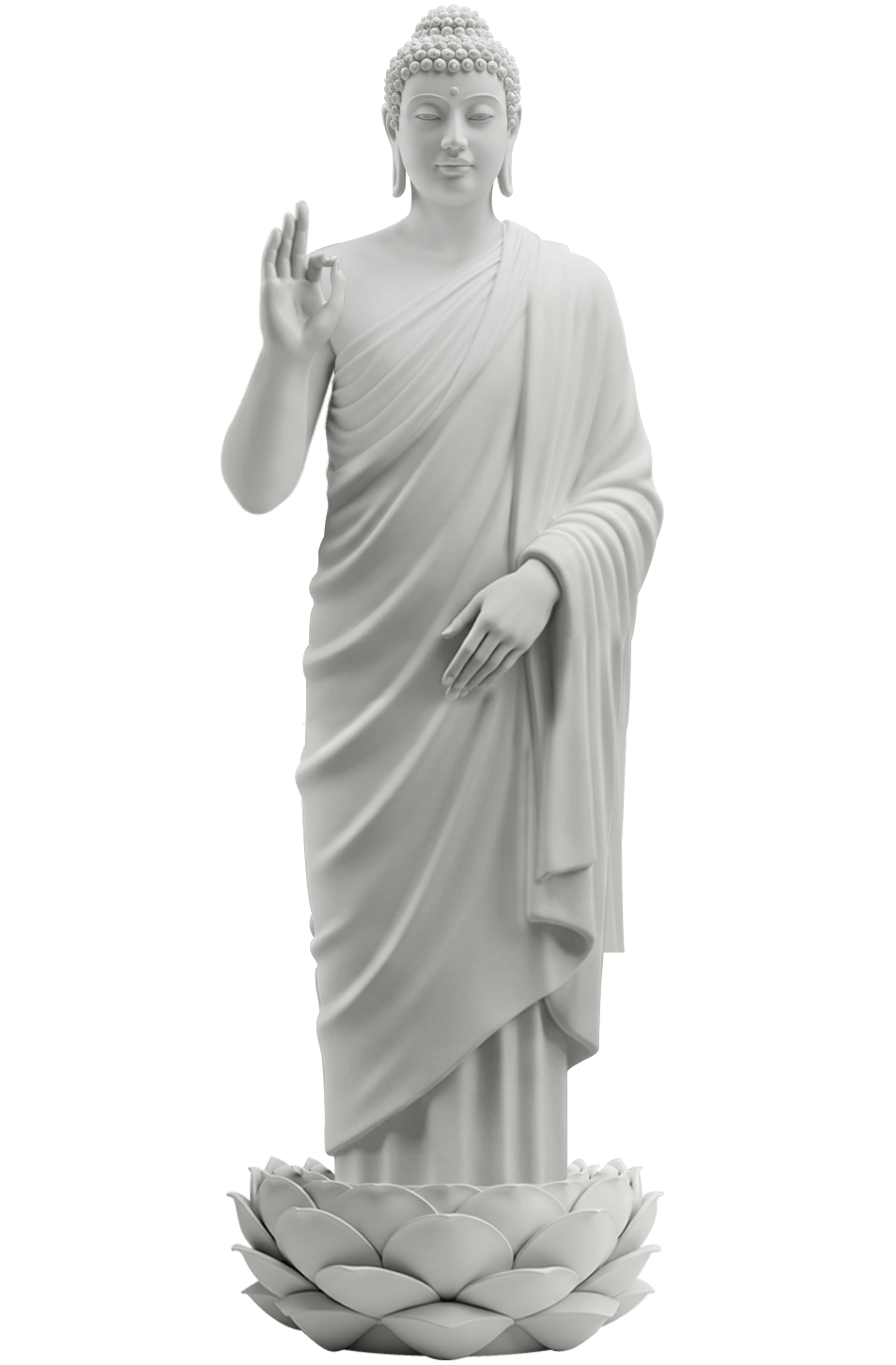

Buddhism began over 2,500 years ago with Siddhartha Gautama, the Lord Buddha in the 6th century BCE in the northern India and it has grown into a religion and a philosophy followed worldwide. Buddhism is considered to be one of the "Big Five" religions in the world. It is also a religion that has caused no war in the name of it.
Unlike many other religions, Buddhism is neither monotheistic nor henotheistic religion which is centered on the belief in the existence of one or more all-powerful gods or deities that are separate from the human world and may influence human lives. Therefore, Buddhism is a non-theistic religion, meaning it focuses on personal development and the cessation of suffering through the teachings of the Buddha rather than the worship of a single supreme god or deities.

Life is full of suffering. We grow old, get sick, and eventually die. Our loved ones grow old, fall ill, and die too. Even moments of happiness carry seeds of grief — for example, the joy of spending time with a child can turn to sorrow when they grow up, change, or leave. So, the seed of this grief, pain, or suffering is our attachment or desire towards the things that inevitably change. To understand this further, you wouldn't feel sorry to see the change of a random child who is not attached to you.
This doesn’t mean you can’t be happy. In fact, Lord Buddha said "Santuṭṭhī paramaṁ dhanaṁ — happiness is the greatest wealth". So, Buddhism isn’t about avoiding joy, but Buddhism teaches that understanding the reality of change — that everything is temporary — helps us face life with calm and consolation. Therefore, at its heart, Buddhism sees desire and attachment as the root cause of suffering. When we learn to reduce and manage these desires, we find inner peace and freedom from endless grief.
Buddhism talks about the rebirth. The attachments and desire is reason why life continues in cycles of birth and rebirth (samsara). However, a person's rebirth will not be as the same person, or sometimes as the same being. Karma or intentional actions is a main factor that determines that. Buddhism explains the cause and effect just as a modern-day science. Actions have consequences. But unlike other religions it also explains four other factors called Niyamas including simply seasonal factors, biological factors, mental factors, and reality that affect the form of rebirth. For example karma would cause for a child to be gifted with beauty, but that child may inherit his parent's features and also inherit the regional features like the skin colour. However, as life is full of suffering, the endless circle of rebirth brings endless suffering. That is what buddha found the way to desist. The way to end the rebirth. By understanding the truth of suffering, its cause, and the way to overcome it, we can ultimately reach nirvana, a state of complete liberation and lasting peace where there is no rebirth hence no suffering.
Buddhism is therefore not about blind faith or worship; it is a path of observation, reflection, and practice. Among many other things Buddhism also teaches how to live an ethical life. Five precepts, not to harm living beings, not to take what is not given, not to misuse the senses, not to speak falsely, not to cloud the mind with intoxicants lays the foundation for it. It also teaches how to face and tolerate "Eight Worldly Concerns" or gain, loss, status, disgrace, praise, censure, pleasure, and pain that continuously blow through people's lives.
When understanding Buddhism, it is important to understand who Lord Buddha addressed. Some teachings are for the Sangha or Bhikkhu. In other words, for the monks who have chosen a life that focuses entirely on the Dhamma trying to live apart from worldly attachments determining highly to attain enlightenment. Some teachings are for the laypeople. And some are for both.
For those new to these ideas, rebirth and karma may seem mysterious or hard to accept — and that is perfectly natural. In Buddhism, questioning is encouraged. Questions are the doors through which understanding enters. The Buddha never asked anyone to follow blindly. Instead, he invited.
Ehipassiko — come, see for yourself
Lord Buddha described his Dhamma as ehipassiko which means "come, see for yourself". In other words, explore it with your own senses and mind. If it resonates with you, follow it. If not, you are free to walk away.
Do not believe anything blindly — even from me, just because it is said, written, or passed down. Investigate it for yourself.
Buddhism always welcomes and encourages questioning.
Attāhi attano nātho — You are your own refuge
Lord Buddha didn’t ask us to pray or depend on him or anyone else for salvation. Instead, Buddhism encourages you to trust in yourself, draw on your inner strength, put personal effort. He showed the way to end suffering. But you are the master of yourself and you have the freedom to walk along it or not.
However, in a way, Buddhism is quite easy for the people to understand: follow the fundamentals like the Five Precepts, question your actions against them. It involves no worship and no deep concepts. When you encounter contradictory interpretations of a concept from people or even monks, you can always return to the fundamentals and see whether they align.
Over more than 2,500 years, Buddhism has developed a rich culture, with traditions, customs, and celebrations woven around it. Some of these practices began during the Buddha’s own lifetime to maintain harmony and order among his disciples. Others evolved after his Parinirvana to preserve the community and keep the teachings intact.
Traditions often serve to slow the pace of change, offering continuity and a sense of identity. Yet, not all traditions define Buddhism itself. They may add beauty and elegance, but at its heart, Buddhism is not about rituals or customs. The Buddha always encouraged people to follow the path he showed — the path to inner freedom and salvation — rather than relying solely on ceremonies or acts of worship.
It is also important to understand that there are different Buddhist traditions, such as Theravāda, Mahāyāna, and Vajrayāna, each with its own practices, customs, and ways of expressing the teachings. One tradition may not look exactly like another — differences are natural. For example, Theravāda Buddhism, or “School of the Elders,” is generally considered more conservative than Mahāyāna. Here, we focus on the core Buddhist concepts, and self-salvation rather than rituals or customs, which is why the emphasis is on Theravāda teachings.
Siddhartha Gautama, later known as the Buddha was the son of King Sudhodana and Queen Maha Maya of kingdom of the Shakyas located, in present-day Nepal. He was not a god but a man made of flesh and blood. His father, King Suddhodana, shielded him carefully from all hardship even from seeing human suffering, surrounding him with palaces, servants, and every comfort and luxury.
However, at the age of 29, Prince Siddhartha encountered the Four Sights — old week man, sick person, death, and a wandering calm ascetic. He realized that the suffering woven into life, and the life is an endless circle, rotates again and again, therefore, suffering again and again. He left behind his royal privileges and luxury, set out to find the truth and end suffering by ending the recurring circle of life.
He studied under the finest teachers, and then he tried severe asceticism to end the suffering in circle of life. He had already experienced the extreme luxury as royalty. Having lived both extremes — luxury and self-denial — Siddhartha saw clearly that neither could bring end to the suffering. He turned instead to a balanced approach, the Middle Way: a path free from extremes, leading to wisdom, compassion, and liberation.
On his 35th birthday, following the Middle Way, attaining mindfulness with meditating he attained enlightenment. From then on, he was the Buddha — the Awakened One. He was known as Gauthama Buddha as per his family name.
For the next 45 years, the Buddha wandered across the Indian subcontinent, teaching the way to salvation from endless suffering, compassion, and wisdom. He welcomed kings and servants, men and women alike, declaring that one’s worth is measured not by birth but by deeds. His first disciples were the Five Ascetics, who soon attained enlightenment under his guidance.
As the Buddha grew older, he understood that his time in this world was drawing to a close. He traveled to Kusinara, or Kushinagar, a town located in northern part of India. At the age of 80, on another Vesak full-moon day just as his birthday and enlightenment took place, the Buddha passed into Parinirvana, the death where there is no rebirth that leads to endless suffering, leaving his final words: "Everything that arises will pass away. Work hard for your own salvation".
After the Buddha’s Parinirvana, his disciples preserved his teachings through recitations and councils, ensuring the Dhamma would live on. But its spread across regions and cultures was made possible largely through the support of kings and lay patrons.
Even during the Buddha’s lifetime, kings such as Bimbisāra of Magadha, Pasenadi of Kosala, Udena of Vatsa, and Ajātaśatru of Magadha became devoted followers, offering protection to the Sangha and helping the teachings flourish in their kingdoms. Wealthy patrons like Anāthapiṇḍika and others also played vital roles in supporting monasteries and the growing community.
The most remarkable turning point came under Emperor Ashoka (3rd century BCE) of the Maurya Dynasty. Deeply moved by the suffering caused during his conquest of Kalinga, Ashoka embraced Buddhism and made it a guiding principle of his rule. He promoted Dhamma as a way of peace, compassion, and moral governance.
Ashoka didn’t impose Buddhism by force but encouraged its practice through moral example, inscriptions, and edicts carved on rocks and pillars across his empire. Most importantly, Ashoka’s missions carried the Dhamma far beyond his own empire. He sent Buddhist missionaries to southern India, including Mahismandala (Mysore), Vanavasi (Northern Kanara), Aparantaka (Northern Gujarat, Kathiawar, Kachchh, and Sindh), and Maharattha (Maharashtra). To the north, he extended missions to Kashmir and Gandhara (present-day Pakistan and Afghanistan), and across the Himalayan region (Himavanta). To the east and southeast, the Dhamma was carried to Suvarnabhumi (believed to be parts of modern-day Myanmar and Thailand). To the south, his own son Mahinda Thera and daughter Sanghamittā Therī journeyed to Sri Lanka, where Buddhism flourished deeply. Beyond the subcontinent, missionaries were also sent westward to Yona (Greece) and even as far as Syria, Egypt, and Macedonia.
Thus, Buddhism transformed from a regional tradition in northern India into a world religion. Later rulers such as Emperor Kanishka also known as Kanishka the Great of the Kushan Empire also supported its growth, helping it spread along the Silk Road into Central Asia and China. Then from China, it gradually traveled to Korea and then to Japan. Through these royal patrons, and dedicated monks, Buddhism crossed borders and cultures, becoming a spiritual path for millions across Asia and, eventually, the world.
Over more than 2,500 years, Buddhism has spread across cultures and continents, adapting to the languages, customs, and needs of the people who practiced it. As a result, several traditions or “schools” of Buddhism developed. They share the same foundation — the teachings of the Buddha on suffering, impermanence, compassion, and the path to liberation — but they express and emphasize them in different ways. The three main schools are Theravāda, Mahāyāna, and Vajrayāna.
Theravāda is the oldest surviving school of Buddhism, found mainly in Sri Lanka, Thailand, Myanmar, Laos, and Cambodia. It preserves the earliest scriptures in the Pali Canon and emphasizes personal practice, meditation, and living according to the original teachings. Its goal is to become an Arahant — one who has reached enlightenment and ended rebirth. Theravāda places strong focus on mindfulness, simplicity, and the Noble Eightfold Path.
Mahāyāna arose a few centuries after the Buddha’s time and spread widely across China, Korea, Japan, Vietnam, and beyond. It emphasizes compassion and the ideal of the Bodhisattva — someone who seeks enlightenment not only for themselves but also to help all beings. Mahāyāna traditions often include a rich variety of texts, philosophies, and practices, from Zen meditation in Japan to Pure Land devotion in China.
Vajrayāna developed within Mahāyāna and is most closely associated with Tibet, Bhutan, Nepal, and Mongolia. It combines meditation, rituals, symbolism, and esoteric practices to speed up the path to enlightenment. Vajrayāna emphasizes the guidance of teachers (lamas), with the Dalai Lama being its most well-known figure today.
Buddhism is a living practice. Today, it is followed by millions of people across the world, from Asia to the West.
At its core, Buddhism carries the timeless truth and message of compassion, mindfulness, and wisdom. These qualities guide people to live with kindness, face challenges with clarity, and discover peace within themselves and ultimately reach the enlightenment ending the suffering. In a world that is constantly changing, the teachings of the Buddha continue to offer a steady light — not as dogma to be believed, but as a path to be walked and experienced.