
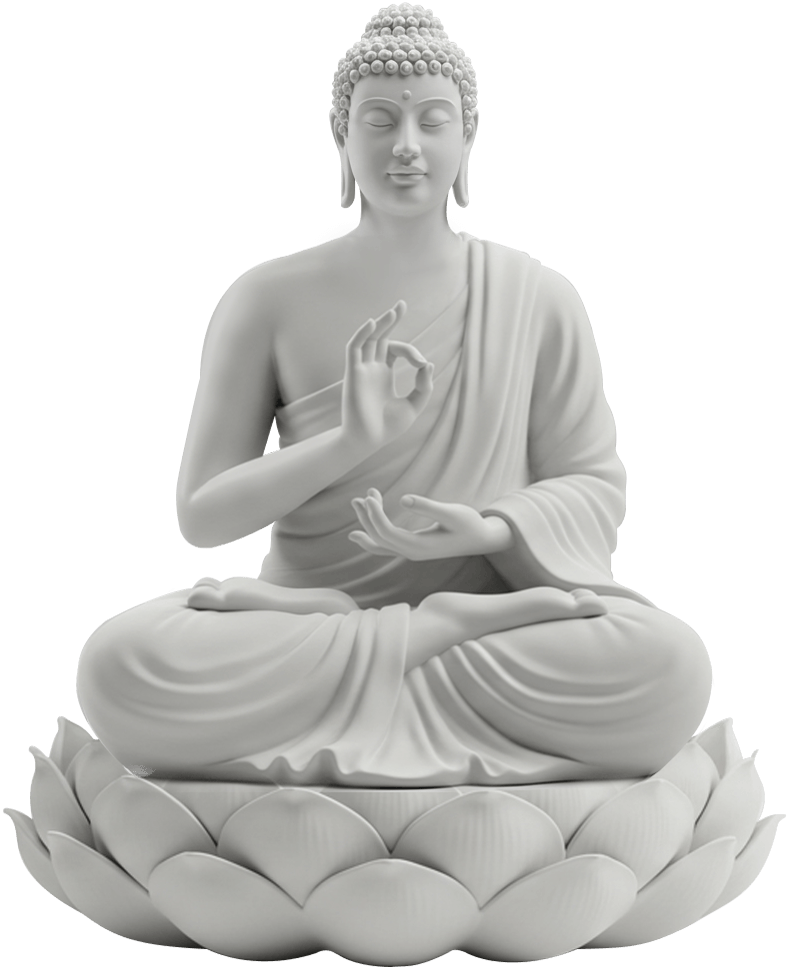


Buddhism began in the 6th century BCE in Northern India. At that time, the land we now call India was not one united country, but a vast region of many kingdoms, republics, and confederacies. The political life of this time was surprisingly well-organized. Kings and clan leaders governed with councils, alliances were made through diplomacy and war, and trade routes linked distant cities. Caste divisions were deeply rooted in society, shaping people’s duties and opportunities.
Religious life was equally diverse. The Brahmins, priests of the Vedic tradition, performed rituals and sacrifices, while wandering ascetics, philosophers, and spiritual seekers roamed from place to place, debating the meaning of life, suffering, and liberation.

It was into this world that Siddhartha Gautama was born, in the kingdom of the Shakyas, a state in present-day Nepal region. His father, King Suddhodana, ruled the land, and Siddhartha was raised in the luxury of royalty. His mother, Queen Mahā Māyā, passed away just seven days after his birth, and he was lovingly cared for by her sister, Mahā Pajāpatī Gotamī, who became his step mother.
At his birth, wise men prophesied that the child would either become a Chakravarti — a universal monarch, “king of kings” — or renounce the world to become a fully awakened Buddha. His father, wishing for the former, sheltered him carefully from every sight of suffering, surrounding him only with beauty, comfort, and joy. His father even built him three palaces to stay comfortably in different seasons.
Prince Siddhartha grew into a young man of great skill and discipline, mastering martial arts, politics, philosophy, and all princely studies. He later married Princess Yasodharā, and their life seemed filled with promise and privilege.
However, at the age of 29, everything changed. On his way to the royal gardens, Prince Siddhartha unexpectedly encountered four sights: an old man, a sick person, a corpse, and finally, an ascetic. These encounters got him to deep thinking and revealed the truths of life — aging, illness, and death — sufferings no one could escape — and the possibility of a life seeking peace beyond them.
One evening, a final realization struck. A performance was held in the palace, filled with music and dancers of great beauty. Prince Siddhartha enjoyed it for a time, but fell into sleep. At midnight he awoke suddenly. The same performers, once so radiant, now lay asleep on the floor, their bodies slack, their faces ungraceful, their beauty gone as if they were lifeless corpses. In that moment, Prince Siddhartha saw clearly: all beauty fades, all things change, nothing lasts.
Realizing the impermanence of every worldly pleasure, he resolved to seek the only peace that endures — the eternal freedom of the spirit. And so, Prince Siddhartha made his great decision: to leave behind the palace, his wealth, and even his beloved family, and set out in search of truth.
That night he quietly left the palace walls, stepping away from a life of comfort into the unknown. He left behind the familiar sounds, scents, and sights of the royal life — the surrounding servants, the fragrance of gardens, the soft luxury of silk and gold. With nothing but determination, courage, and compassion in his heart, he clad in simple robes, began the journey of a seeker — a journey to understand the nature of suffering, to discover the path to lasting peace, and to bring freedom and wisdom to the universe.
Ascetic Siddhartha went first to the most respected teachers of his time — masters of meditation and philosophy. He studied deeply, practiced their methods with great dedication, and soon reached the highest states they could offer. Yet, he felt the truth he sought — the end of suffering — was still beyond those attainments.
At that time, it was commonly believed that severe ascetic practices — denying the body every comfort, enduring pain and hunger — were the way to reach the highest level of spirituality. Determined to test this path, ascetic Siddhartha practiced with extraordinary discipline. He wore rags, slept in the forest, and reduced his food until he was little more than skin and bone.
Impressed by his determination, Five Ascetics joined him, convinced he would soon attain enlightenment through this extreme way.
But after six long years of hardship, ascetic Siddhartha realized that this path, too, could not bring true peace. Weak in body and mind, he saw clearly: neither the life of luxury he had once known, nor the life of severe self-denial, could lead to freedom. Both were extremes. The way forward lay between them — the Middle Way which later taught as the Noble Eightfold Path.
When he accepted food again to regain his strength, the Five Ascetics lost faith in him, believing he had abandoned the path. They left him behind. But ascetic Siddhartha had not given up. In fact, he had just discovered the true direction — the path that would lead him to awakening.
Restored in body and clear in mind, ascetic Siddhartha sat beneath a great Bodhi tree by the river Neranjana, in Bodh Gaya. He crossed his legs, placed his hands gently in his lap, and made a firm vow: “Let only my skin, sinews, and bones remain. I will not rise from this seat until I have found the end of suffering.”
Through the night, ascetic Siddhartha turned his mind inward with deep meditation. In the first watch of the night, he recalled countless past lives, seeing the endless cycle of birth and death. In the second watch, he saw how all beings are caught in this cycle, driven by their actions (karma), bound by ignorance and craving. In the final watch of the night, he saw the deepest truth: the Four Noble Truths — the nature of suffering, its cause, its end, and the path leading beyond it.
As the morning star rose, Siddhartha’s mind became completely free — freed from greed, hatred, and delusion. On the full-moon night of Vesak, when he was 35, he attained complete awakening. From that moment, he was no longer merely ascetic Siddhartha, the seeker. He was the Buddha — the Awakened One.
The Buddha had found the Middle Way, discovered the truth of life, and opened the path to liberation for all beings.
After attaining enlightenment, the Buddha traveled to Deer Park at Sārnāth (Isipatana Migadāya), an ancient town, near Varanasi, to share his insight. There, before the Five Ascetics — his former companions — he gave his first sermon Dhammacakkappavattana Sutta Dhammacakkappavattana Sutta Says about the Middle Way and the Four Noble Truths: the reality of suffering, its cause, the possibility of its cessation, and the path to liberation — the Noble Eightfold Path. , or “Setting the Wheel of Dhamma in Motion,” opening a path of understanding and freedom for all who wish to follow.
The Five Ascetics became the Buddha’s first disciples, known as the Five Monks. After hearing this first sermon, ascetic Kondañña realized the teaching and attained the first spiritual stage of the Buddhist path, called Stream-Enterer (Sotāpanna). On the fifth day, the Buddha gave a second sermon, Anatta Lakkhana Sutta Anatta Lakkhana Sutta Explains the absence of a permanent self (anatta) and how clinging to a self leads to suffering. . After listening to this second sermon, Kondañña and the other four monks eradicated all mental defilements and attained Arahatship, the final stage of spiritual liberation attaining the enlightenment.
The Buddha’s teachings were aimed at helping everyone — not just monks — to live wisely and with compassion. At the heart of his message are the Four Noble Truths, which reveal the reality of suffering, its cause, the possibility of its end, and the path to liberation — the Noble Eightfold Path.
Beyond meditation and spiritual practice, he gave guidance for everyday life. He taught how to live ethically, cultivate generosity, honesty, and compassion, and build harmonious relationships with family, friends, and community. He offered advice on fair governance, just taxation, ethical business, and social responsibility. His wisdom showed that every action matters and that inner growth and ethical conduct are intertwined.
For laypeople, this guidance was not abstract; it was a practical roadmap for living fully, responsibly, and peacefully, creating a life of meaning and respect for all beings. The Buddha invited everyone to observe, reflect, and practice, discovering truth through their own experience, not by blind faith.
After the first disciples attained enlightenment, the Buddha’s teaching began to spread. Kings, nobles, and wealthy patrons soon became devoted followers. Among them were King Bimbisāra of Magadha, King Pasenadi of Kosala, King Ajātaśatru of Magadha, King Udena of Vatsa, the wealthy merchant Anāthapiṇḍika, and many others. Even his stepmother, Mahāpajāpatī Gotamī, became the first ordained nun, showing that women too could walk the path to liberation.
Unlike many movements of the time, Buddhism did not spread by force or conquest. At that time, social divisions and caste distinctions were deeply rooted in society. People were often judged by their birth rather than their character. He refused to accept birth as a measure of worth — any person could rise high or fall low based on their deeds, not their lineage. He welcomed kings and servants, the wealthy and the poor, men and women alike, treating all with equal compassion. In his community of followers, the Sangha, there was no higher or lower — only seekers of truth walking the same path — showing that liberation was possible for anyone who walked the path.
Rather than gathering a grand crowd to surround him, the Buddha sent his disciples out individually, instructing them, “Let not two go by the same way,” so that more hearts could be reached. He himself wandered from place to place, walking freely through villages, forests, and towns, teaching wherever there were minds ready to receive the truth. In this way, the message of peace, wisdom, and compassion spread gently, touching all who were open to it.
As the Buddha grew older, he understood that his time in this world was drawing to a close. He traveled to Kusinara, or Kushinagar in present-day India, where he chose to spend his final days surrounded by his disciples. There, he prepared for his passing away, while continuing to teach, reminding them that the greatest way to honor him was not through rituals or monuments, but by practicing the path he had shown.
At the age of 80, on a Vesākha full-moon day — the same day celebrated as his birth and enlightenment — the Buddha entered Parinirvana, the final liberation from the cycle of birth, death, and suffering.
His last words were, "Everything that arises will pass away. Live with awareness, and work hard for your own salvation"